

March 2026 KPA CTP of the Month: Pogun In
When did you start training, and how has the industry changed since you started?
I started my journey about five years ago, initially as a guardian trying to resolve my own dog’s reactivity. For the past three years, I’ve been working professionally as a trainer. Since then, I feel the industry has changed rapidly, with a massive influx of information and content. The advancement of AI has been a game-changer for me, making high-quality international resources much more accessible. When I first started the DTP, I had to translate English materials one by one, and the quality of translation tools wasn’t great at the time. It was quite a struggle to grasp the exact context of technical training terms!
I’ve noticed a shift in the industry toward prioritizing the function of behavior, which I’ve also been studying in depth lately. On the other hand, I see a rise in aversive training methods that claim to be “science-based.” Unfortunately, these trainers often use media more effectively to gain influence. While logical, evidence-based debates between different approaches are necessary, I believe it ultimately comes down to who can best convince and satisfy clients and the market. Still, I remain optimistic because I see more and more skilled new trainers who truly care about animal welfare than when I first started.
Was there a particular dog/animal in your life that was your most important teacher?
My dog, L'addition, and the shelter dogs I’ve worked with have been my most important teachers. L'addition was reactive toward people and other dogs when I started the DTP program. In fact, my entire career and identity as a trainer have been shaped by my journey to help L'addition. While I’ve learned to analyze and understand his behavior deeply, and he’s improved tremendously, we still haven't fully resolved his reactivity. He constantly throws new challenges and questions my way. Sometimes it feels like a hurdle, but it always ends up being the catalyst for my next leap as a trainer. L'addition truly is my "dog teacher."
He constantly throws new challenges and questions my way. Sometimes it feels like a hurdle, but it always ends up being the catalyst for my next leap as a trainer.

What is your favorite activity or sport that you do with your own dog(s)?
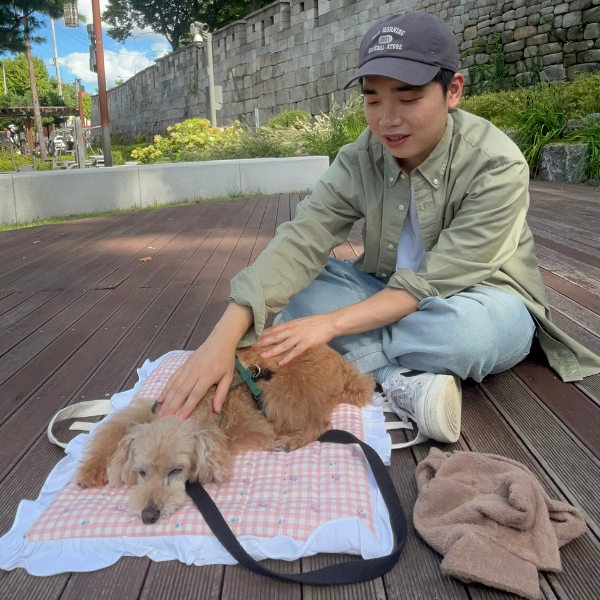
I’m not exactly an "active" person, and L'addition is already 13 years old. My favorite thing is simply walking with him and my girlfriend, Dahee, in the quiet, spacious parks of Seoul. We also love visiting our favorite cafés in Seongbuk-dong; I let L'addition relax in a camping chair in their gardens while we enjoy a drink. But if I had to pick the absolute best moments, it’s those evenings spent on the sofa, petting L'addition while Dahee and I watch Netflix and eat something delicious.
What is your proudest training moment?
There are a few moments that make me particularly proud. One specific moment was when the owner of one of my regular cafés told me, after watching L’addition for a year, that his reactivity had noticeably improved.
More broadly, I feel proud whenever a client tells me their dog is calmer since our sessions, or at the shelter, when a dog that once ran away from me finally stands in front of me, asking to be petted.
Do you have a memorable or touching training story you’d like to share?
There are two episodes from my shelter work that I’ll never forget. Once, there was a dog named Kong-al who loved people but wasn’t very motivated by treats. My colleague Dahee Kim watched from outside the fence and suggested, “What if you just pet him?” As soon as I did, he settled down comfortably. After that experience, my perspective on training changed significantly.
Another time, Poong, also a shelter dog, was barking at me so fiercely that it was genuinely terrifying. To be honest, I was a bit scared, so I had my arms crossed tightly. My colleague Mika Ishihara said, “Stretch out your hand,” and that simple action changed everything. To my surprise, Poong began to truly enjoy being petted by me. These experiences taught me to think more deeply about a dog’s reinforcers and the topography of their behavior. It’s a bit heartbreaking to realize these dogs were simply asking for connection through those behaviors, and seeing that change is incredibly moving to me.
What do you do to continue your training education?
Lately, I’ve been fascinated by Applied Behavior Analysis and am learning more about it through various lectures. Last year, I traveled to Japan with colleagues for a PORTL workshop led by Mika Ishiwata. Currently, I’m learning the Constructional Approach through NPO CAAWT, run by Sean Will, Ph.D., and Maasa Nishimuta, M.S. I also spend time sharing and analyzing videos with fellow trainers. To access international webinars and materials more comfortably, I’m also learning English. Even with AI these days, I’ve realized that to truly grasp the depth of the material, I need to improve my own language skills. Additionally, the webinars regularly hosted by KPA Korea are very helpful to me.
Who has been your inspiration in the animal training community?
I draw inspiration from so many people. In Korea, Jung-hyun Lim first introduced L’addition and me to clicker training. Terry Ryan helped guide me when I was questioning whether continuing as a trainer was the right path for me. Alex Lee and Dan Lee also opened many opportunities for me as a trainer. Then there are Dahee Kim and Mika Ishihara, who introduced me to the Constructional Approach and continue learning alongside me. I was deeply impressed by Mika Ishiwata’s PORTL instruction in Japan, and I enjoy Barbara Heidenreich’s YouTube content. Finally, the community at CAAWT, including Sean Will, Ph.D., and Maasa Nishimuta, M.S., is always inspirational.
How has completing the Dog Trainer Professional program and becoming a KPA CTP changed your life and career?
To be honest, earning the DTP itself didn’t change my life or career overnight, but it gave me tremendous confidence. I believe the process of personally practicing and truly grasping the core concepts of dog training is “golden.” The real strength of this program lies in discussing with mentors, sharing challenges with peers, and finding solutions together. What really matters, I think, is how actively you engage with the CTP community after becoming certified. When I earned mine, I was lucky that Alex Lee was very active in KPA Korea, which allowed me to network with many wonderful people. That networking gave me the confidence to pursue various opportunities, and looking back, those experiences eventually became my career. To me, the DTP is a fantastic opportunity to connect with great trainers once you’ve established your foundational knowledge and experience.
Do you have any memorable stories from your time in the DTP?
Watching Terry Ryan’s attitude toward her students and her teaching style, I learned a great deal about the mindset of a professional trainer and instructor. She was incredibly graceful, dignified, and warm. I would really love to take her workshop again. I still often think of the crisp March air in Sequim and the deer family that appeared in the front yard.
I also dearly miss my DTP classmates and Airbnb mates, Ariel and Jae. They packed my lunch every morning and looked after me so well. At home, I am the eldest of three brothers, but with them, I felt like I had two older sisters. Thanks to them, I enjoyed the program even when my English was still lacking.
Outside of dog training/dog sports, do you have any hobbies?
I love making music. I don’t create anything grand, but I enjoy connecting a MIDI controller to my MacBook and composing short tracks. I often "secretly" include them in my Instagram content. Lately, after watching Culinary Class Wars on Netflix, I also enjoy cooking Korean food as a hobby. I find that music and cooking are quite similar to training—our subjective effort and sense of achievement may differ from the actual satisfaction of listeners or eaters. Since there is no single "correct" answer in the process of creating a result, I often feel they all share a similar essence.
What is the most important piece of advice you can give to a new trainer?
That’s a tough question. I don’t feel I’m in a position to give advice to others yet, whether in terms of knowledge, skill, or business. However, if I were giving advice to myself when I was just starting this journey, I would say this:
Be confident, yet stay humble. When training doesn’t go as planned, don’t resent the dog or the guardian. Instead, calmly look back at your own training plan to find the flaws. To do this effectively, keep a record of everything. As you build your career, there’s no need to criticize others—just stay focused and devoted to the direction you believe is right. Avoid using methods you cannot explain accurately, and always remain open to the potential of new ideas. And finally, give affection to people, just as you do to animals.
How can people learn more about you?
@seongbukdong_poodle_poodle and @bbobbogul on Instagram
Blog
Email